I think in trees. Every plan I make starts as a root node with branches hanging off it, and for the last year those trees lived in h-m-m, a tiny PHP mind mapper that runs in the terminal. One file per map, tabs for depth, hjkl to move around. I loved it.
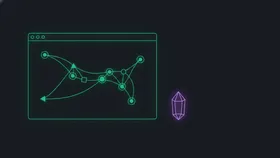
Then my backend map grew a branch called infra, which grew a branch called redis, and suddenly I was scrolling sideways through a 60-node tree to find the thing I opened the map for. h-m-m has no idea that other maps exist. You get one file, and that file is your whole world.
Also, it needs PHP. Fine on my Mac, a chore on the Linux box where most of my stuff runs now, a no on a Raspberry Pi.
So I did the thing you should never do, and rewrote it. Meet hmx.
What changed, what did not
The layout engine, the keys, the file format, all the same. An h-m-m map renders identically in hmx, because I ported the layout functions one by one with the same names and the same arithmetic, then checked the Go output byte for byte against tmux captures of the PHP version. Those captures are frozen in the repo as golden files.
What is new is everything one map cannot do on its own:
- A list screen.
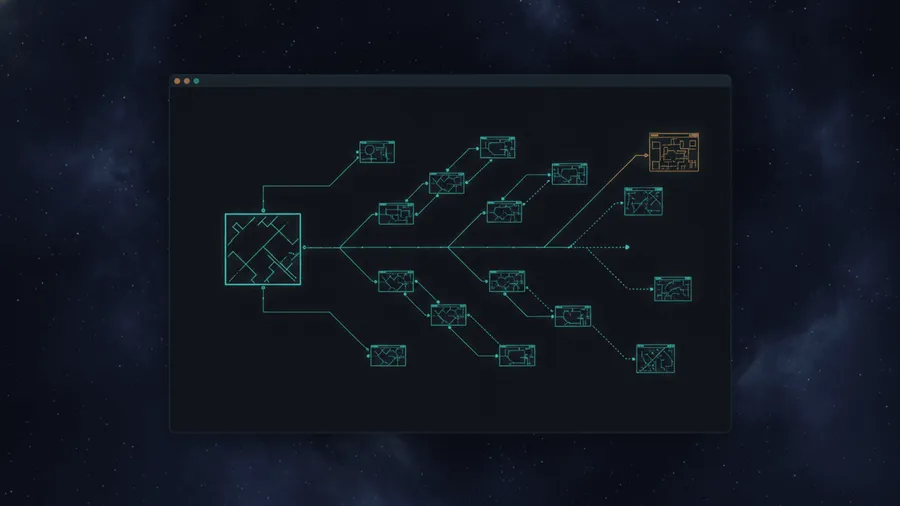
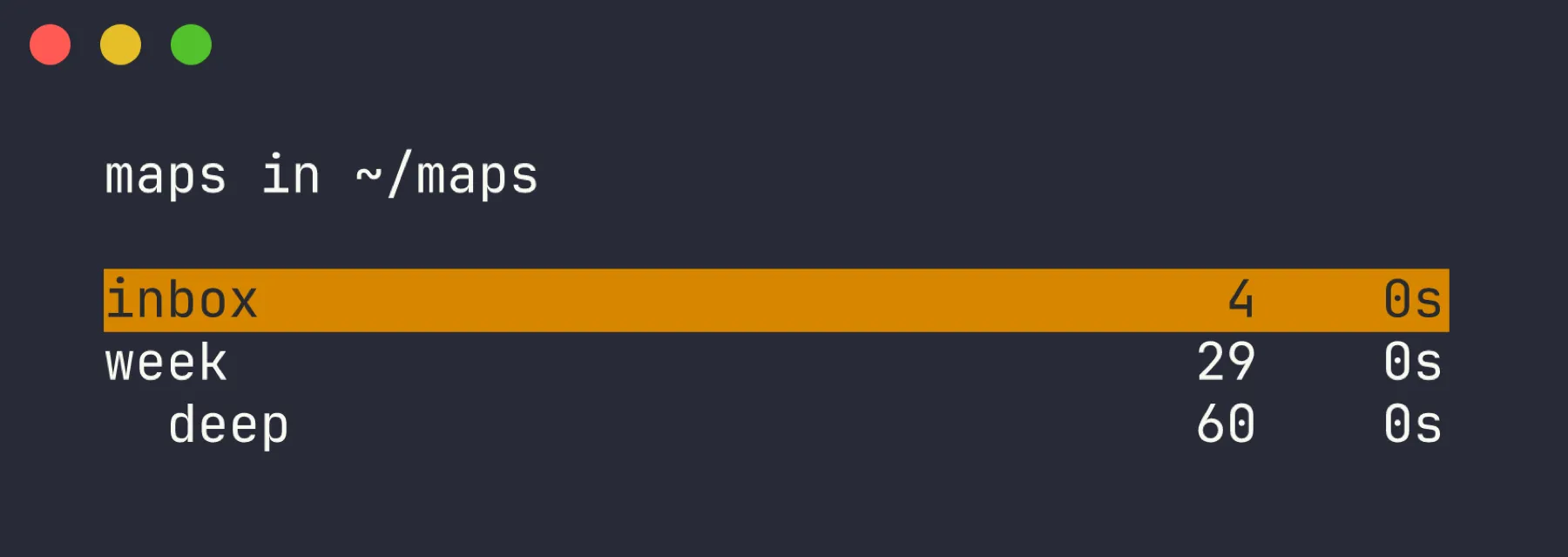
hmxwith no argument shows every map in the folder, nested under whoever links to it, with node count and age. - Links.
[[infra]]in a node title jumps toinfra.hmm.[[infra#redis]]lands on that node.Backspacecomes back, and a breadcrumb shows the trail. - Extract.
Ctrl-Eon a node moves the whole subtree into its own map and leaves a link behind. This is the one I wanted most. Big maps stay small. - Bodies. A node can carry a few lines of notes.
Eopens them in$EDITOR, they show in a pane at the bottom.
![A map with a breadcrumb, a [[deep]] link and a node with a body](/_astro/link.DIM3qxw1_UuxxX.webp)
Here is the whole file format. This is backend.hmm, with tabs shown as arrows:
backend
→	auth
→	→	JWT rotation
→	→	> Rotate every 24h.
→	→	refresh
→	[[infra#redis]]
And this is what it looks like on screen:
                 ╭── auth  [+]
   backend ──────┤
                 ╰── [[infra#redis]]
Press Enter on the link:
backend › infra [1]
               ╭── redis
   infra ──────┤
               ╰── postgres
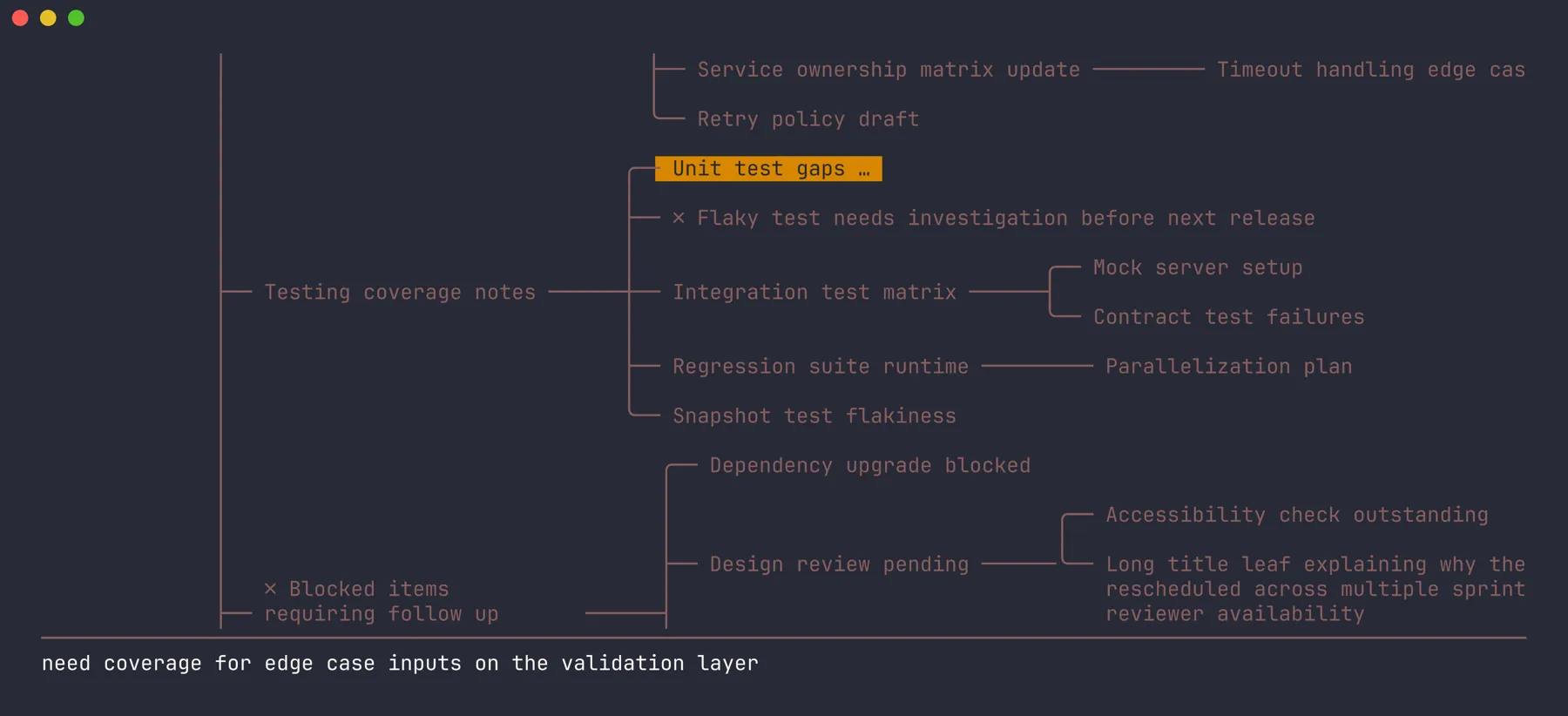
A node with notes shows … after its title, and the notes sit in a pane at the bottom while it is selected:
No ids. No index. No database. The backlink engine is grep. If you rename a map, hmx rewrites [[old to [[new across the folder and tells you how many files it touched. Sync is git, hmx never talks to a network.
The rules I wrote before the code
I have shipped enough side projects that turned into feature soup, so this time I wrote a foundations.md first and checked every change against it:
- Plain text, readable by upstream h-m-m and by
cat. - One map in memory. No tabs, no splits.
- Links are text.
- Fewest keys. h-m-m has 86 bindings, hmx has 24 on the map and 7 on the list.
- No editor inside the editor. Bodies go to
$EDITOR. - Shortest diff wins, once the problem is understood.
The “out of scope” list is longer than the feature list. No graph model, no backlink panel, no drawn arrows, no templates, no timestamps, no sync. Every one of those was tempting, and every one of them is what makes the other tools feel heavy.
How the port actually went
I did not go straight to Go. Version one was a PHP fork with the new screens bolted on. Ugly, but it proved the spec and gave me an oracle. Same fixtures, same tmux smoke tests, both binaries had to pass. Once Go passed everything, PHP got retired to a git tag.
The Go side is one package main, flat files, one App struct where PHP had a global array. Two dependencies, tcell and go-runewidth. The binary is 5 MB and starts before you finish pressing Enter.
The Taskwarrior bit
My team lead workload lives in Taskwarrior, so I wired the two together in the smallest way I could. A node with [[task:uuid8]] in its title renders a ☐ or ☑, red when overdue. t on a node opens a picker over pending tasks and links one, or creates a task from the node title. That is it. Nothing else writes to Taskwarrior, and without a task binary everything just renders as a plain box.
I already put my Obsidian vault in the terminal this month. Now the mind maps are there too, in a folder of text files I can grep, diff and commit. Trees, all the way down.