Your next user won’t have a browser. They won’t click buttons, scroll through dashboards, or squint at loading spinners. They’ll call your API, parse the JSON, and move on — in milliseconds.
AI agents are becoming the primary consumers of software. Not as an edge case. Not as an integration. As the default client. And most software isn’t ready for them.
The Great Inversion
For decades, we’ve built software around a simple assumption: a human is sitting at a screen. Every pixel, every animation, every loading state — designed for human eyes and human patience.
That assumption is crumbling.
Bain & Company projects that “in three years, any routine, rules-based digital task could move from ‘human plus app’ to ‘agent plus API’.” Traditional B2B SaaS funding dropped 60% year-over-year in Q4 2025, while AI-native enterprise platforms raised record amounts. The market has already voted.
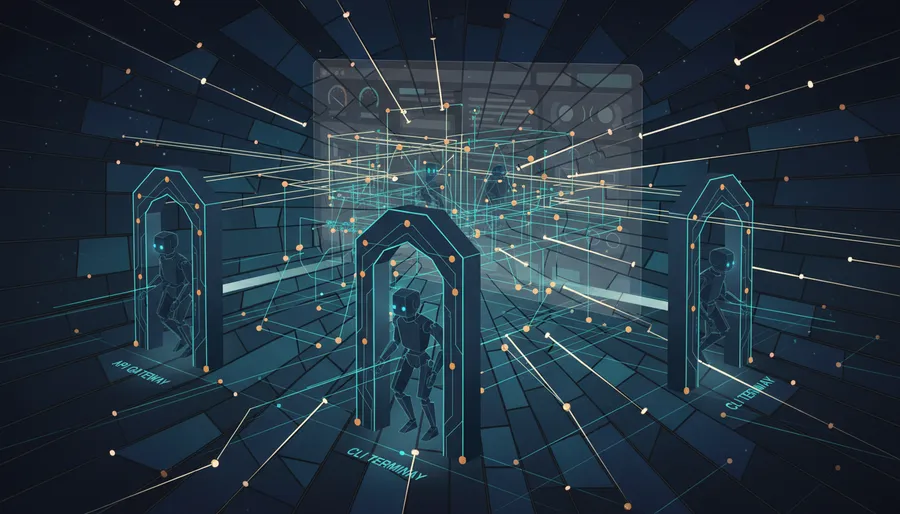
The inversion is simple: APIs and CLIs are now the front door. The UI is the side entrance.
APIs Are the New Front Door
Stripe gets this. Their Agentic Commerce Suite isn’t a dashboard — it’s an API and SDK suite designed for AI agents to complete purchases autonomously. They co-developed the Agentic Commerce Protocol with OpenAI so agents can handle entire checkout flows without a human touching a screen.
Salesforce re-engineered their applications to be “headless capabilities for agents, evolving from monolithic UIs to back-end services that agents can dynamically call via APIs and events.” They signed over 5,000 Agentforce deals in a single quarter.
When you’re building for agents, your API design principles shift:
- Structured, machine-readable responses — JSON schemas, not HTML templates
- Context preservation — agents work in multi-step loops and need state
- Reduced round-trips — every extra call costs tokens and latency
- Composability — small, stateless endpoints that chain together
- Discoverability — describe your tools so agents can find and use them
Your API isn’t plumbing anymore. It is the product.
CLIs: The Agent’s Native Tongue
Here’s a stat that should change how you think about interfaces: a device compliance task that consumed ~145,000 tokens through MCP took only ~4,150 tokens via CLI. That’s a 35x reduction.
GitHub’s MCP server alone eats ~55,000 tokens of context before any work begins. A well-designed CLI preserves ~95% of the context window for actual reasoning.
Why are CLIs so agent-friendly?
- Models were trained on them. Billions of lines of terminal interactions in the training data. CLI is their native language.
- Unix composability works. Pipes, flags,
--help,--output json— these aren’t legacy patterns, they’re agent primitives. - They’re self-documenting. A
--helpflag tells the agent everything it needs to know. No SDK installation, no auth dance, no token negotiation. - They’re token-efficient. Plain text in, structured text out. No protocol overhead.
Companies like Sentry are already shipping CLI-first agent tooling. Not because CLIs are trendy, but because they’re the most efficient interface an agent can use.
If you have an API, wrap it in a CLI. If you have a CLI, make sure it speaks JSON.
The Death of the Dashboard (Mostly)
This doesn’t mean all UI dies. But its role changes fundamentally.
The mundane work — data entry, status updates, routine approvals, report generation, ticket creation, basic CRUD — agents will handle all of it. No human in the loop means no UI required.
What survives is narrow and specific:
Audit dashboards. The new dashboard “looks less like Salesforce and more like Datadog” — logs of decisions made, money spent, confidence intervals. You’re not doing the work; you’re watching the agents do it.
Human-in-the-loop screens. When an agent hits a decision that exceeds its confidence threshold — a large purchase, a policy exception, a customer escalation — it surfaces a focused approval screen. Not a full application. A single decision point.
Reporting and analytics. Humans still need to understand trends, set strategy, and make judgment calls. The reporting layer survives because it serves human cognition, not human labor.
Everything else? Automated. The agent doesn’t need a pretty form to fill in a field. It needs an endpoint.
How to Build for Agents Today
This isn’t a future prediction. You can start now:
-
Make your API the product. If your API is an afterthought bolted onto your UI, you’re building for yesterday. Design the API first, build the UI on top of it (if at all).
-
Add CLI wrappers to every service. A thin CLI that wraps your API calls and outputs JSON. It takes a day to build and makes your entire service agent-accessible.
-
Return structured responses. Every endpoint should return machine-parseable data. If an agent has to scrape HTML to use your product, you’ve already lost.
-
Design for composability. Small, stateless, pipeable operations. An agent should be able to chain
list-users | filter-active | export-csvwithout reading your docs. -
Expose tool descriptions. Whether it’s MCP-compatible schemas, OpenAPI specs, or just good
--helptext — make your tools discoverable by agents. -
Keep decision screens for humans. Don’t eliminate UI. Eliminate unnecessary UI. If a screen exists to automate a routine task, the agent should handle it. If it exists for judgment, keep it.
The Market Has Already Voted
The AI agents market hit $5.4 billion in 2024 with a projected 45.8% CAGR through 2030. Stripe, Salesforce, OpenAI, and Microsoft are all shipping agent-first interfaces. The per-seat SaaS pricing model is dying — agents don’t buy seats.
The companies that win the next decade won’t be the ones with the prettiest dashboards. They’ll be the ones whose APIs are so clean, so composable, and so well-documented that an agent can integrate with them in seconds.
Your next million users won’t have screens. Build for them.